Hi, I'm Richard, the founder of Attribute Media. We've been running SEO for clients for twenty-one years.
Most of your competitors are not doing SEO properly, and I can pretty much guarantee it. Ranking on Google takes technical work, consistent content, a site people like using, and authority built up over time.
Most business owners will never do all of that, because the results are not immediate. It takes patience, diligence and resolve. Knowing that is your opportunity: you can come out ahead of all of them, with the right team and the right plan.
Done properly, SEO builds traffic you own. It doesn't stop the moment you stop paying. A business with three years of solid SEO behind its website now owns a valuable, commercial asset. A business that has only run ads for three years has a bill.
The signals Google ranks on are largely the signals ChatGPT and the AI assistants use to decide who to cite. SEO done well today is also your AI visibility. The same work now pays twice, on Google and in the AI answers, and there has never been a better moment to get ahead in two different lanes at once.
Google, and every other search engine, looks for three things. Are you relevant? Does your page answer what the person actually searched for? Are you reliable? Do you have a visible reputation across the internet? And do people have a good experience on your site? Does it load fast? Do visitors find the information they need, or get in touch with you? Google measures all of this precisely, and the site that scores best is the one it recommends first.
Oona Wellness came to us with a hundred and fifty bookings a month from search. Organic visitors have since tripled to seventeen thousand a month, and search now brings them over eleven hundred appointments a month. Cassar HVAC had a website for a full year with barely any visitors and no leads. In the third month after we rebuilt it, over two thousand visitors and twenty booked appointments. And there are many more.
A free SEO review takes thirty minutes. We look at your site's technical health, what you rank for today, and who's ahead of you, and we'll offer a proposal that meets your budget. Book your review below.
Google's results have become more competitive. Generic, thin SEO no longer works at all. Agencies that used to get results by stuffing keywords into pages and building cheap links have found their clients slipping. Properly executed SEO now has a clearer advantage because the bar for what ranks has risen.
Authority also accumulates. A business that started three years ago is harder to displace today: its content has aged and deepened, its links have multiplied, its technical foundation has settled. In three years, the same will be true of the businesses that start now.
SEO performance now directly influences AI search visibility. Domain authority, technical health and structured content are the signals Google uses to rank pages, and they are largely the same signals ChatGPT, Perplexity and Google AI Overviews use to decide what to cite. A business investing in SEO today is also building visibility in AI search.
Generative engine optimisation adds one more layer: content structured for AI citation, entity consistency across the web, and citation tracking across platforms. It builds on SEO rather than replacing it, because a tool cannot cite authority a site has not yet earned. We offer GEO on its own and combined with SEO. If you are already doing SEO, adding GEO is the next step.
Before any content or link work, a site needs to be crawlable, fast, and structured in a way Google can understand. Once it is, on-page work maps each page to a keyword target, and local SEO gets the business into Google Maps and local results. What comes out the other end is organic search: traffic that arrives without paying for every click, and compounds month over month.
Done properly, SEO builds traffic you own. Unlike paid ads, it doesn't stop the moment you stop paying. That's the fundamental difference, and why businesses that invest in SEO early compound their advantage over those that rely on paid traffic alone. A business with three years of solid SEO behind it has an asset. A business that has been running ads for three years has a bill.
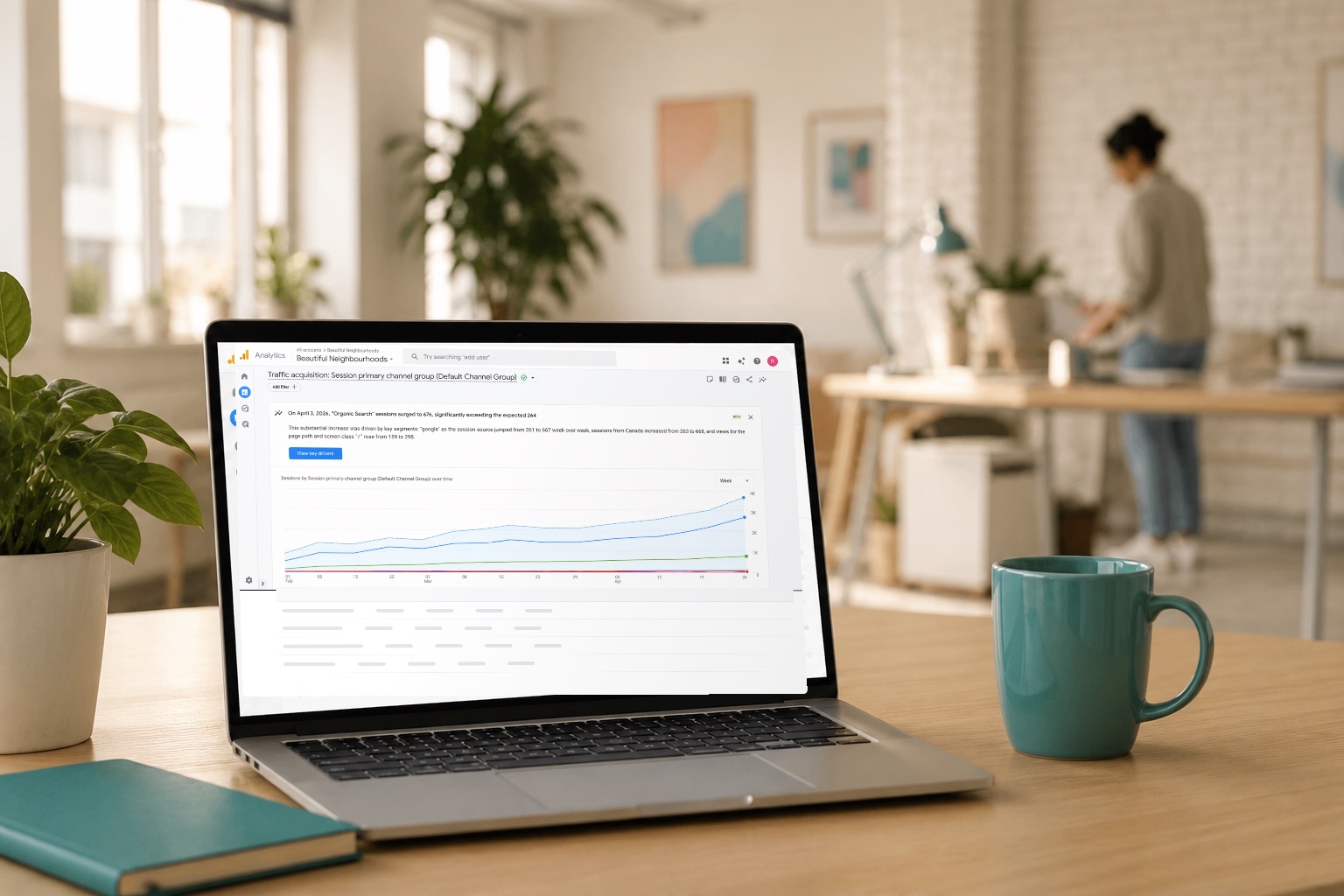
Most businesses picture SEO as blog posts, meta titles, and ranking for their own name. The comparison below shows how far that picture is from the work.
| What most businesses think SEO is | What SEO actually is |
|---|---|
| Writing blog posts | Technical site health first |
| Stuffing keywords into pages | Matching real search intent |
| A one-time project | A compounding monthly programme |
| About Google rankings only | About Google AND AI search visibility |
| Optional for small businesses | The highest-ROI channel for most businesses |
| Fast results | 3-6 months to meaningful movement |
The six things inside every SEO contract.
Most sites carry technical problems actively suppressing their rankings: page speed, crawlability, schema, Core Web Vitals. We find and fix them first, because nothing else works on a broken foundation.
Learn moreWe identify the terms your potential customers are using at every stage of the buying process and map them to the right pages on your site. We use real commercial intent data from Ahrefs.
Learn moreWe optimise every page to match its keyword target: headings, meta data, content structure, internal links, schema markup. Pages that are properly optimised rank faster and hold their position longer than pages that are technically correct but poorly structured.
Learn moreWe plan and produce content that earns rankings: long-form guides, service pages, location pages, built around real keyword data and written to be more useful than what currently ranks. Content that gets cited by AI tools because it is clear, specific and authoritative.
Learn moreWe build backlinks from relevant, credible sources that increase your domain authority and your likelihood of being cited in AI search. Quality over volume: links that Google and AI tools treat as endorsements.
Learn moreKeyword rankings, organic traffic, conversions from organic search: reported monthly in plain language. We connect the work we're doing to what's happening in your business.
Learn moreReal results from businesses across e-commerce, trades, professional services and media.
"Before Attribute Media we had a website for a full year, barely any visitors, and zero leads. In the first month after launch we had over a thousand visitors and ten new phone calls. That changed everything."
"Attribute Media grew our website traffic from 500 visits per month to over 5,000. That kind of growth opens doors you didn't even know existed. New client enquiries followed directly."
"We had no website, no Google presence, and no leads. Attribute Media built everything from scratch. We now dominate the search rankings across Durham Region and get consistent enquiries every week."
"We worked with Attribute Media for one year and as they promised, they tripled our traffic. More importantly they gave us the SEO foundations to continue building on that success ourselves."
"The most important thing Attribute Media did was help us understand what our traffic was actually worth to our sponsors. Our website traffic doubled after their rebuild. We can't thank them enough for that insight."
"For several years Attribute managed our SEO and got us to number one in North America for silver jewellery, ranking above Tiffany and huge international brands. We couldn't be more grateful."
If someone types a query into Google and your business should be the answer, SEO determines whether they find you or a competitor. The industry matters less than the intent behind the search.
Organic search drives more sustained revenue for e-commerce than almost any other channel because it captures buyers at the moment of highest intent. A brand ranking for its product categories owns that traffic permanently, not just for as long as the ad budget runs.
Lawyers, accountants, architects and consultants are searched for by clients who are ready to hire. A professional services firm ranking for its specific practice areas in its target cities is consistently generating qualified enquiries without paying for every click.
Plumbers, electricians, HVAC companies and contractors are searched for by homeowners who need someone now. Local SEO, ranking in Google Maps and local organic results, is the single highest-ROI marketing channel for most trade businesses.
For brands selling at scale, SEO compounds faster than almost any paid channel because rankings apply across thousands of product and category queries simultaneously. A national brand with strong organic rankings builds a traffic asset that pays dividends for years.
Our clients are based across North America. New York, Chicago, Los Angeles, Toronto, Vancouver, Miami: wherever you are, the work is the same. If you want to know what your current SEO situation looks like and where the biggest opportunities are, we can show you.
Yes, and it is worth more now than it was five years ago. Two things changed. Google's results became more competitive, which means thin SEO no longer works at all while genuinely good SEO has a clearer advantage than it used to. And your search performance now decides whether AI tools cite you: the signals ChatGPT, Perplexity and Google AI Overviews lean on are largely the ones Google already weighs, so an SEO programme has become an AI visibility programme as well. The honest caveat is that SEO is not right for everyone. If nobody searches for what you sell, if you need customers this month rather than next quarter, or if your site is about to be replaced, the money is better spent elsewhere first. Where it does fit, the case is the compounding. Paid traffic stops the day the budget stops. A page that ranks keeps producing visitors at no marginal cost, and every additional page, review and citation makes the next one easier to rank. A business that has been doing this properly for a year is in a position a competitor cannot buy their way into quickly. The trap to avoid is treating SEO as a monthly fee for blog posts. The work that earns rankings is technical health, pages built around real search demand, and authority from sources that already have it.
For most businesses starting from a reasonable baseline, meaningful movement begins within three to six months. Local SEO moves faster, often within four to eight weeks, because Google Maps responds to profile completeness, proximity and review activity rather than to the slower work of authority building. The sequence is fairly consistent. Technical fixes show up first, sometimes within weeks, because you are removing something that was actively suppressing the site. New pages start collecting long-tail searches, the specific and question-shaped ones, a month or two after they are indexed. Competitive head terms take the longest and in a crowded category can take a year of consistent work. Three things decide where you land in that range: how competitive your category is, how much technical debt the site is carrying, and how quickly content and authority get built. The compounding is the part worth planning around, since a business twelve months in is dramatically harder to displace than one three months in, and the gap widens rather than closes. What we do not do is disappear for six months and then present a report. Rankings, impressions and organic conversions get reported monthly from the start, so you can see movement in the leading indicators long before the revenue arrives.
Technical SEO is the work that makes a website easy for a search engine to find, crawl, understand and rank. It covers site speed and Core Web Vitals, mobile performance, URL structure, internal linking, schema markup, crawl budget, canonical tags, redirects and the indexing rules that decide which pages are eligible to rank at all. Most businesses are carrying problems they do not know about. The common ones we find are pages that only render their content through JavaScript, so a crawler sees an almost empty page; duplicate content created by filters or parameters, which splits the value of a page across a dozen URLs; redirect chains left over from an old site; missing or wrong schema; and a robots or noindex rule that has been quietly excluding a section since the last redesign. Any of those can hold a site down regardless of how good the content is. This work comes first for a simple reason: content and links amplify what is already there, so building either on a broken foundation wastes the spend. It is also the least glamorous part of the discipline and the part most often skipped, which is why an audit on a site that has never had one usually finds gains available in weeks rather than months.
SEO retainers for small and mid-sized businesses typically run between $1,500 and $5,000 a month in the US and Canada, depending on how competitive the category is, what state the site is in and how much work is in scope. Some agencies charge less and deliver less, usually four blog posts and a report. Some charge considerably more for the same outcomes. In a working programme the money goes on technical fixes, keyword and intent research, writing pages that deserve to rank, earning links and mentions from sources that already have authority, and the monthly analysis that decides what happens next. The first month or two often costs more than the ongoing rate if there is a serious technical backlog or a site migration involved. The better question is not what SEO costs but what a ranking is worth to you. Work out what a customer is worth over a year, and how many extra customers a month would justify the fee. In most categories that number is small enough that a single well-ranked commercial page covers the programme. If your maths does not work at $1,500 a month, we will say so, and paid search or conversion work on the traffic you already have is usually the better first move.
SEO gets your business ranked in a list of results. GEO, generative engine optimisation, gets your business cited inside an AI-generated answer from tools like ChatGPT, Perplexity and Google AI Overviews. The two are closely related, because authority, technical health and structured content feed both. The practical differences are in the writing and in the entity work. A page that ranks can afford to be persuasive; a page that gets cited has to be extractable, which means direct statements, real numbers, and answers that stand on their own without the surrounding paragraph. Entity consistency matters more in GEO than in SEO: if your business name, address, category and service list differ between your site, your Google Business Profile and the directories, a model has no confident answer to give and names someone else. Measurement is different too. SEO is measured in rankings, impressions and organic conversions. GEO is measured by how often you are cited for a defined set of questions, on which platforms, and whether what the answer says about you is accurate. We recommend building both together. SEO without GEO leaves you invisible in a channel that is taking a growing share of research, and GEO without SEO has no authority underneath it to work with.
Directly, yes. When an assistant decides which sources to trust, it weighs much of what Google weighs: who links to you, how clean and fast your pages are, whether your schema says plainly what you do and where you operate, and whether you are described the same way everywhere you appear. In practice an SEO programme is also an AI visibility programme, and the businesses appearing in AI answers today are overwhelmingly the ones that built search authority first. Assistants quote passages, not pages, so a section that answers one question completely in its own words is far more citable than the same information spread across a page. Specifics travel: a price range, a timeline, a process with steps in it, a genuine constraint. Adjectives do not. Third-party mentions carry more weight than they do in classic SEO, because a model treats being described consistently by other people as evidence, so directories, association listings and local press earn their place. And accuracy matters more than volume, since an assistant repeating out-of-date hours or a service you no longer offer costs you a customer as surely as being absent. We check what the tools currently say about a client at the start of every engagement, because the answer is often wrong before it is missing.
A good SEO agency does six things, and skipping any of them is why so much SEO underperforms. It audits the site technically and identifies what is actually suppressing rankings. It fixes those problems rather than listing them. It researches the terms your customers really use, which is rarely the vocabulary the business uses about itself, and maps each one to a single page so your own pages are not competing with each other. It writes or rebuilds the content to answer those searches with real depth, including the questions about price and process that most companies leave out. It earns authority through links and brand mentions from sources that already have credibility, which is slow and unglamorous and is the part cheap retainers quietly drop. And it reports monthly on rankings, traffic and conversions, then changes the plan based on what the numbers show rather than repeating the same activity. Two things a good agency also does that rarely appear on a scope of work: it tells you when the constraint is not SEO, and it tells you what it is not doing. If nobody can explain how this month connected to last month, the programme has become a subscription rather than a plan.
Three measures tell you the real story, and they arrive in that order. Organic sessions in Google Analytics: is the 90-day trend rising, month-to-month noise aside? Impressions and average position in Google Search Console: are you appearing for terms that matter, and is your position on them improving? And leads or sales from organic traffic, because a ranking that does not convert is a vanity metric. Impressions move first, usually within weeks, which makes Search Console the earliest honest signal that something is working. Positions follow, then clicks, then enquiries. If impressions are climbing but clicks are not, the problem is usually the title and description rather than the ranking. If clicks are climbing but enquiries are not, the problem is on the page rather than in search. Two things to be suspicious of in any SEO report: a chart of total keywords ranked, which grows without meaning, and traffic reported without a comparison to the same period last year in a seasonal business. We report all three monthly and tie them to revenue. If they are not moving in the right direction within six months, we explain why and what changes, rather than presenting a dashboard full of numbers that do not connect to your business.
We'll run a quick SEO audit on your site and show you the technical issues holding your rankings back, the keyword opportunities your competitors are taking, and what three months of proper SEO would realistically do for your traffic.
"We had no website, no Google presence, and no leads. Attribute Media built everything from scratch."
"For several years Attribute managed our SEO and got us to number one in North America for silver jewellery, ranking above Tiffany and huge international brands."
"The most important thing Attribute Media did was help us understand what our traffic was actually worth to our sponsors. Our website traffic doubled after their rebuild."
"We had been online for fifteen years with moderate results. Attribute Media tripled our website traffic within a year. New customers find us every day because of it."
Book your call
© 2026 Attribute Media · 50 Carroll Street, Toronto ON
hello@attribute.media